
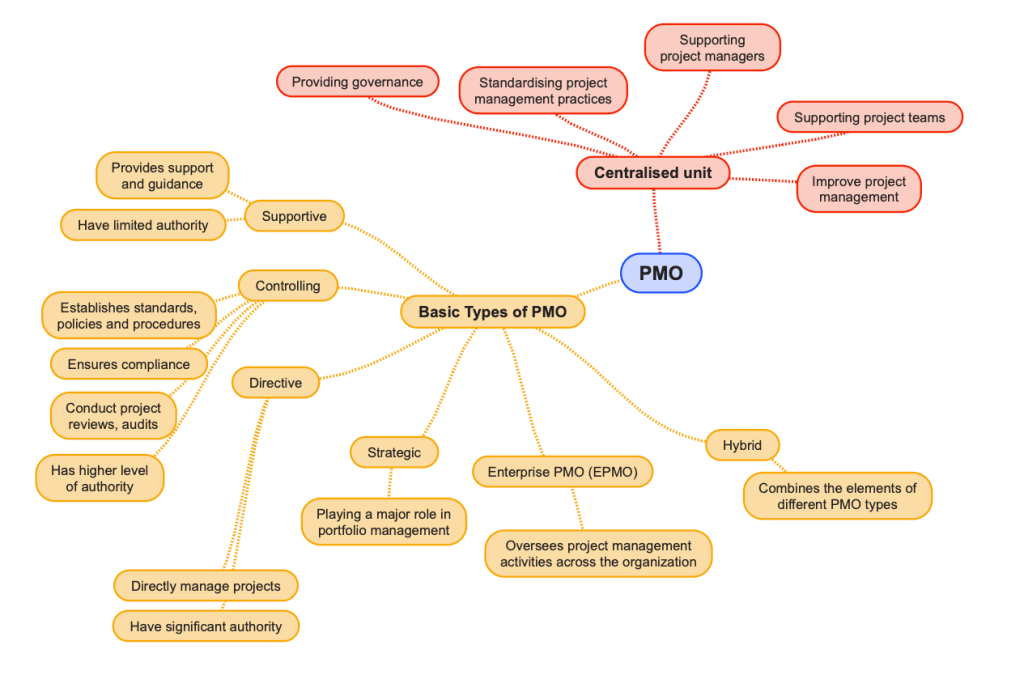
Different types of PMO
Project Management Offices (PMOs) can vary significantly in their structure, functions, and roles within organizations. The type of PMO established often depends on the organization’s size, industry, culture, and strategic objectives. Here are the different types of PMOs commonly found:
- Supportive PMO:
- A supportive PMO provides support and guidance to project managers and teams but typically has limited authority over projects.
- It offers templates, tools, training, and best practices to assist project managers in their project management activities.
- The primary role of a supportive PMO is to facilitate project success by providing resources and expertise as needed.
- Controlling PMO:
- A controlling PMO has a higher level of authority and control over project management processes and practices.
- It establishes standards, policies, and procedures for project management and enforces compliance across projects.
- A controlling PMO may conduct project reviews, audits, and assessments to ensure projects adhere to established standards and guidelines.
- Directive PMO:
- A directive PMO takes a more active role in project management by directly managing projects or project portfolios.
- It may assume responsibility for project delivery, resource allocation, and decision-making on behalf of the organization.
- Directive PMOs often have significant authority and influence over project outcomes and strategic direction.
- Strategic PMO:
- A strategic PMO focuses on aligning projects and project portfolios with the organization’s strategic objectives and goals.
- It plays a key role in portfolio management, project selection, and resource allocation to ensure projects deliver maximum value to the organization.
- A strategic PMO works closely with senior leadership to define strategic priorities and ensure projects support the organization’s overall strategy.
- Enterprise PMO (EPMO):
- An Enterprise PMO (EPMO) is a centralized unit that oversees project management activities across the entire organization.
- It provides strategic direction, governance, and support for project management practices and initiatives.
- An EPMO may encompass multiple types of PMOs (supportive, controlling, directive) and focus on driving organizational excellence in project management.
- Hybrid PMO:
- A hybrid PMO combines elements of different PMO types to meet the specific needs and requirements of the organization.
- It may incorporate supportive, controlling, and directive functions based on project complexity, organizational culture, and strategic objectives.
- A hybrid PMO offers flexibility and customization to adapt to changing circumstances and evolving project management practices.
1. Basic Definitions
- What is a project?
- What is an operation?
- What is a program?
- What is portfolio?
- Project Management Office,PMO).
- Project stakeholders.
- Enterprise environmental factors (EEF).
- Organizational process assets (OPA).
- Project success criteria.
- Roles and responsibilities of Project Managers.
- 12 Project Management Principles
 PMguides